
Marc Taylor built his career around one core belief: that business skills and a commitment to justice belong together. As a leader at Chief Seattle Club, he uses his background in strategic planning and organizational leadership to develop solutions that address homelessness and housing insecurity for Native communities in the Pacific Northwest. A Georgetown University McDonough School of Business graduate, Marc shows that a business education can be a powerful tool for serving your community and creating real, lasting change for people who need it most.
Their story
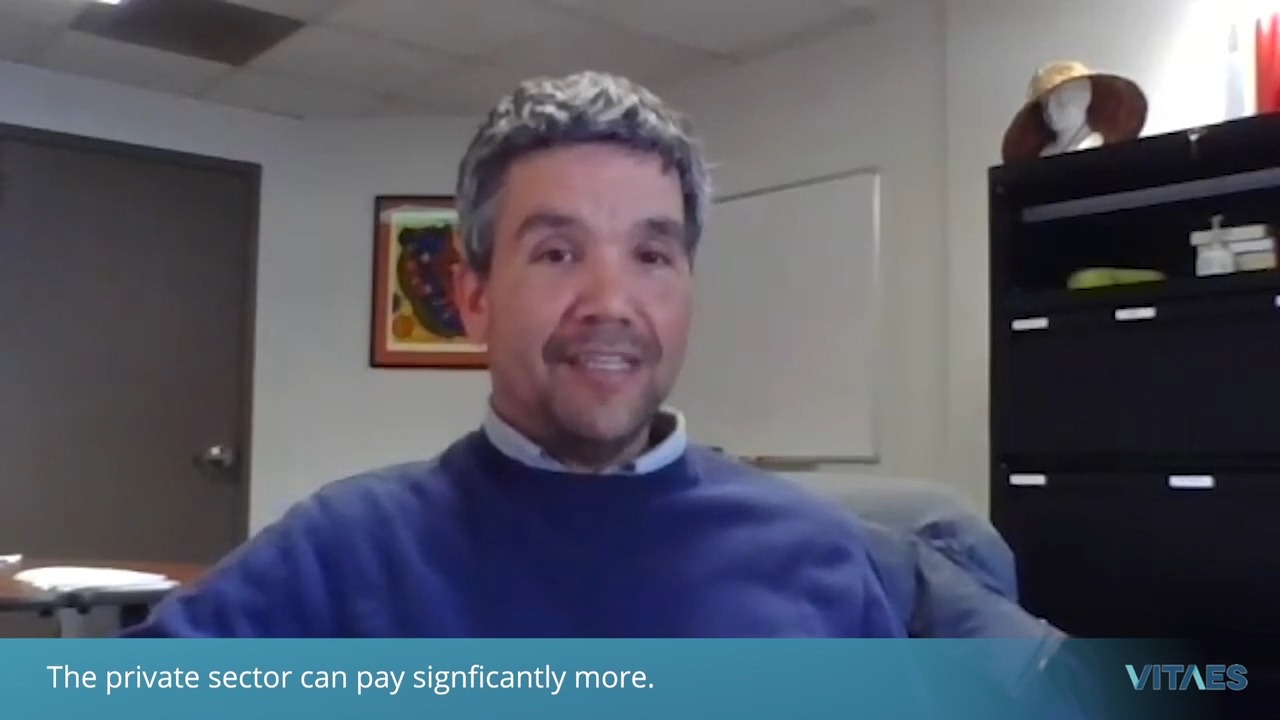
Accountant - You don't need a four-year degree to start.
20 min
Watch the full story →
Watching requires a free Vitaes account.
Key quotes
“In the nonprofit world, you get that sense of doing good. So I would encourage them to do it. And what they should look for is look for a mission that they really value.”
Marc Taylor, CFO
“As long as the organization exists, there will always be a need for accountants. You could work in Australia, you could work in Europe or Africa. Everyone does accounting. We all do it the same way — debits and credits.”
Marc Taylor, CFO
“I'm Native American. I enjoy working with communities that are marginalized and helping them find equity. And so that gives me more joy than the money that I'm making.”
Marc Taylor, CFO
“I took a Native American class and I learned for the first time about Native American heroes. I grew up to be ashamed of being Native American. And when you get to college, you are educated into a wealthier diversity of history of the world, and it gives you a different perspective.”
Marc Taylor, CFO
“You got to believe in yourself. You got to challenge yourself. By always working on my weaknesses, I think that really paid off for me.”
Marc Taylor, CFO
Career highlights
Accounting gives you job security that program staff often don't have — as long as the organization exists, they need an accountant.
Marc explains that grant-funded program staff risk layoffs when funding dries up, but accounting roles persist through the life of any organization.
You don't need a four-year degree to start — an associate's degree can get you in the door at around $25/hour, and a CPA unlocks six-figure salaries.
Marc lays out a clear earnings ladder: associate's degree gets you started, CPA gets you to $100K+, and MBA can take you to CFO-level pay.
Look for a mission that matches your values — working in nonprofit accounting lets you use financial skills to serve communities you actually care about.
Marc contrasts working for a for-profit gas company (where the mission felt hollow) with working for Native and Black communities in Seattle (where the work feels meaningful).
Challenge yourself academically even when it's hard — working on your weaknesses builds the kind of discipline that opens unexpected doors.
Marc studied chemical engineering as an undergrad despite struggling with advanced math, and that discipline later helped him score in the 92nd percentile on the GMAT.
When someone believes in you and opens a door — take it. And remember that luck goes both ways; you have to be ready when good luck shows up.
Marc credits his high school counselor for submitting his UW application and recognizes that without that push, his life could have gone in a completely different direction.
If you understand budgets, you're ahead of most program managers — accounting knowledge is a launchpad into leadership roles across the whole organization.
Marc notes that transitioning from accounting to program management is surprisingly straightforward because most program managers struggle with the financial side.